


News
We'll get back to you as soon as possible.
Biogas to Hydrogen Production: A Real Solution for Clean Energy
The energy world is talking about hydrogen. But not all hydrogen is clean. Most comes from natural gas. That process releases carbon. There is a better way. Using waste to make hydrogen solves two problems at once. It captures methane that would otherwise escape. It creates a zero-carbon fuel. This is where biogas to hydrogen production enters the picture. The technology is ready. The equipment exists. And the market is growing fast.
Turning farm waste, landfill gas, or sewage digester gas into hydrogen is not science fiction. It happens today. The process combines biogas upgrading with steam methane reforming or advanced pyrolysis. Then you add carbon capture. The result is green hydrogen with a negative carbon footprint. For equipment manufacturers in the biogas space, this is the next frontier. More project developers are asking for integrated solutions. They want to go beyond biomethane. They want hydrogen.
If you are evaluating this path, start with the basics. What equipment do you need? How does the chemistry work? What are the real-world economics? This article answers those questions. No hype. Just practical information for engineers and project developers.
For a closer look at the core upgrading systems that feed into hydrogen production, visit biogas to hydrogen production equipment solutions.
Why Convert Biogas to Hydrogen Instead of Just Using Biogas?
Raw biogas is useful. You can burn it for heat or power. You can upgrade it to biomethane for pipeline injection. But hydrogen offers unique advantages. It burns without CO2. It works in fuel cells at higher efficiency than combustion engines. It can be stored long-term and transported as a gas or liquid.
Hydrogen also commands higher prices than biomethane in many markets. California, Japan, South Korea, and Europe have hydrogen subsidies. Low-carbon fuel standards reward hydrogen made from waste biogas. The carbon intensity score for biogas to hydrogen production is often negative. That means you earn credits while selling the fuel.
There is another reason. Hydrogen opens industrial markets. Refineries need hydrogen. Fertilizer plants need ammonia. Steel mills are switching to hydrogen for direct reduction. These buyers pay premium prices. They sign long-term contracts. That makes project financing easier.
How Biogas to Hydrogen Production Actually Works
Let us walk through the process step by step. It starts with raw biogas from an anaerobic digester or landfill. Typical composition is 55-65% methane, 35-45% CO2, and trace gases like H2S and siloxanes.
Step one: Biogas upgrading. You remove H2S, moisture, and siloxanes. Then you separate methane from CO2. Membrane technology works best here. It delivers 97-99% pure methane with high recovery rates. The separated CO2 can be captured for industrial use or sequestration.
Step two: Steam methane reforming (SMR). The purified methane reacts with steam at high temperature (700-1100°C) over a nickel catalyst. This produces synthesis gas – a mixture of hydrogen (H2), carbon monoxide (CO), and some residual CO2. The reaction is endothermic. It requires external heat.
Step three: Water-gas shift reaction. The synthesis gas passes through a shift reactor. CO reacts with steam to form additional H2 and CO2. This maximizes hydrogen yield.
Step four: Purification. Pressure swing adsorption (PSA) separates hydrogen from CO2 and other impurities. Output purity reaches 99.99% or higher. That is fuel cell grade.
Step five: Carbon capture (optional but recommended). The CO2 stream from upgrading and SMR can be captured and liquefied. This improves carbon intensity scores. It also adds a revenue stream from liquid CO2 sales.
The whole process fits into a standard industrial plant. Small-scale systems exist for flows as low as 200 Nm³/h of raw biogas. Larger installations process 2,000+ Nm³/h.
Core Equipment for Biogas to Hydrogen
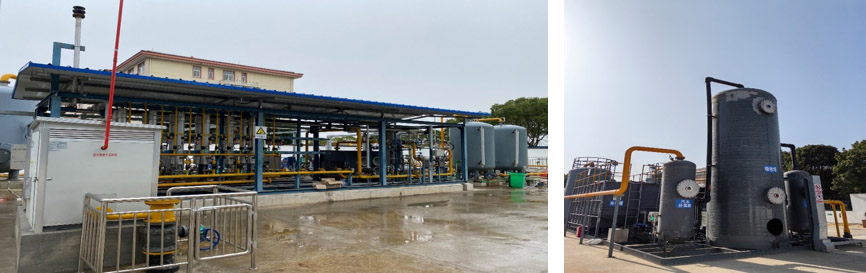
You cannot build a reliable plant without the right components. Here is what a typical biogas to hydrogen production facility includes:
Biogas pretreatment skid – Removes H2S (biological or chemical scrubbing), siloxanes (activated carbon), and moisture (refrigeration or desiccant drying).
Membrane upgrading unit – Separates methane from CO2. Multiple stages achieve high purity.
Compressor station – Raises methane pressure to 15-25 bar for the reformer.
Steam methane reformer – Heated reactor with catalyst tubes. Often integrated with a burner that uses off-gas from PSA.
Water-gas shift reactors – High-temperature and low-temperature shift stages.
Pressure swing adsorption (PSA) unit – Purifies hydrogen to 99.99%.
CO2 capture and liquefaction – Optional but valuable. Produces liquid CO2 as a co-product.
Hydrogen compression and storage – Compresses H2 to 250-900 bar for tube trailers or cascade storage.
Each component must work together seamlessly. The biggest risk is contamination. Sulfur poisons the reformer catalyst. Chlorides and siloxanes damage membranes. Good pretreatment is non-negotiable.
Membrane Technology: The Critical First Step
Membranes determine the efficiency of everything downstream. If your methane purity is low, the reformer produces less hydrogen. If recovery is poor, you waste feedstock. Modern membrane systems solve both problems.
Here is how they work. Compressed biogas passes through thousands of hollow polymer fibers. CO2 permeates through the fiber walls faster than methane. The system captures methane as the retentate at pressure. CO2 exits at low pressure. Three membrane stages in series achieve methane purity above 98% with recovery over 99%.
For biogas to hydrogen production, high methane recovery matters more than absolute purity. Every molecule of methane lost is hydrogen not made. That is lost revenue. Good suppliers guarantee both purity and recovery. They also offer containerized systems. A 40-foot container can process 500 Nm³/h of raw biogas. That makes deployment fast and modular.
Some projects use a different approach. They skip methane separation and reform the raw biogas directly. This works but requires larger reformers and more downstream purification. The economics favor membrane separation except at very small scales.
Steam Reforming vs. Autothermal Reforming vs. Pyrolysis
Three main technologies convert methane to hydrogen. Each has pros and cons.
Steam methane reforming (SMR) is the most common. It offers high efficiency (65-75%) and simple operation. The downside is CO2 production. You need carbon capture to make the hydrogen truly green. SMR works well for biogas to hydrogen production at scales from 500 to 5,000 Nm³/h of feed gas.
Autothermal reforming (ATR) combines partial oxidation with steam reforming. It uses oxygen instead of external heat. This produces a synthesis gas with less nitrogen dilution. ATR is more compact than SMR. But it requires an air separation unit or oxygen supply. That adds cost. ATR makes sense at very large scales (>5,000 Nm³/h).
Pyrolysis is newer. It heats methane without oxygen. The methane splits into hydrogen and solid carbon (not CO2). This is attractive because carbon can be sold or landfilled. No carbon capture needed. But pyrolysis is less mature. Catalyst life is short. It works best for small, distributed biogas to hydrogen production (under 200 Nm³/h). Expect more commercial plants in the next three to five years.
Most investors choose SMR with carbon capture today. It is proven. It is bankable. The technology risk is low.
Carbon Capture: Turning a Problem into a Product
SMR produces CO2. About 0.5 kg of CO2 per kg of hydrogen. Without capture, that hydrogen is not low-carbon. With capture, the carbon intensity drops dramatically. Capture rates of 90-95% are achievable with amine scrubbing or membrane systems.
The captured CO2 can be vented. That is a waste. Better to liquefy it. Liquid CO2 sells for $50-150 per metric ton depending on market. Beverage carbonation, dry ice production, and enhanced oil recovery are common buyers. For a medium-sized biogas to hydrogen production plant making 1,000 kg of H2 per day, CO2 sales add $150,000-450,000 annually.
Some projects go further. They inject CO2 into greenhouses to boost plant growth. Or they use it for pH control in the anaerobic digester. The point is simple: captured CO2 is an asset, not a liability. Design your plant to capture and utilize it.
Economics and Market Drivers
Is biogas to hydrogen production profitable? The answer depends on location and scale. Three factors drive the numbers.
Hydrogen selling price. Industrial hydrogen trades at $2-6 per kg. Retail hydrogen for fuel cells at $10-15 per kg. Your plant will likely sell at industrial prices unless you build your own fueling station.
Feedstock cost. Raw biogas is often free or negative cost. Landfills and farms pay to dispose of waste. But you need a steady supply. Digester gas from food waste has higher methane content than manure gas. That matters.
Subsidies and credits. Low-carbon fuel standards in California, Oregon, and British Columbia pay $100-200 per metric ton of CO2 avoided. For hydrogen from biogas, credits often exceed the fuel value. European renewable hydrogen schemes are similar. These subsidies are the real economic driver.
A typical plant processing 1,000 Nm³/h of raw biogas (60% methane) produces about 300 kg of hydrogen per day. Capital cost is $5-8 million. Operating cost $1.50-2.00 per kg of H2. Selling price $4-6 per kg with credits. Payback period of 4-7 years. That is viable for many developers.
Real-World Projects You Should Know
Several commercial biogas to hydrogen production plants are running today.
California, USA – A landfill gas project uses membrane upgrading followed by SMR. It produces 1,200 kg of hydrogen daily. The hydrogen fuels municipal buses and garbage trucks. Carbon credits cover 40% of operating costs.
Netherlands – A dairy cooperative processes manure from 20,000 cows. The biogas becomes hydrogen for greenhouse heating and fuel cell forklifts. Excess hydrogen is injected into a local pipeline.
Japan – A food waste digester feeds a small pyrolysis unit. The system makes 100 kg of hydrogen per day plus solid carbon. The carbon goes to a battery anode manufacturer. No CO2 is emitted.
These are not pilot plants. They are commercial facilities earning real returns. The technology is de-risked.
Challenges and How to Overcome Them
No technology is perfect. Here are the real challenges with biogas to hydrogen production.
Feedstock consistency – Biogas composition varies daily. Membranes handle this well. But the reformer wants stable methane flow. Solution: buffer storage. Install a gas holder after upgrading to smooth out fluctuations.
Catalyst poisoning – Sulfur kills reformer catalysts. Even 1 ppm of H2S is too much. Solution: polishing guard beds. Use zinc oxide or iron oxide beds after the main H2S removal. Replace them annually.
Scale – Very small flows under 200 Nm³/h are hard to justify. Below this threshold, consider compressed biomethane instead. Or use electrolysis with renewable electricity. Biogas to hydrogen production needs volume.
Permitting – Hydrogen is a hazardous gas. Local fire codes may restrict storage pressure and quantity. Work with an experienced engineering firm early. They can navigate the approvals.
Off-gas utilization – The PSA unit produces a tail gas with residual methane and hydrogen. Burning it in the reformer burner works well. But you need the right burner design. Don't vent it – that wastes fuel and emits methane.
Selecting an Equipment Partner
You need more than individual components. You need an integrator who understands the whole chain from raw biogas to hydrogen. Look for these qualities:
Membrane expertise – Do they manufacture their own membranes? What recovery rates do they guarantee?
Reformer experience – Have they built SMR systems for biogas feed? How do they handle variable composition?
Carbon capture integration – Can they supply CO2 liquefaction as an add-on?
Reference plants – Visit an operating facility. Talk to the owner about uptime and maintenance.
Service support – What is the response time for a broken compressor or fouled membrane?
Avoid suppliers who have never done a full biogas to hydrogen production plant. Stick with those who offer complete skid-mounted systems. They take responsibility for integration. That reduces your risk.
For detailed specifications on the upgrading front end, including containerized membrane units and CO2 liquefaction, visit biogas to hydrogen production equipment.
The Future: Distributed Hydrogen Hubs
The big trend is decentralization. Instead of one giant hydrogen plant, we will see many small hubs. A farm makes hydrogen for its own tractors. A landfill fuels the local garbage fleet. A wastewater plant powers fuel cell generators for the grid.
Biogas to hydrogen production fits this model perfectly. The feedstock is local. The product is used locally. There are no long pipelines or expensive transport. Each hub is small enough to permit quickly but large enough to be economic.
Equipment makers are responding. They now offer modular systems in standard container footprints. A 20-foot container for upgrading. A 40-foot container for reforming and PSA. Another 20-foot for CO2 capture. You add containers as production grows. This modularity lowers upfront capital. It also allows phased investment.
Expect to see hundreds of these hubs in the next decade. The waste is there. The technology is ready. The market is hungry
Biogas to hydrogen is not a distant dream. It is a working solution for renewable fuel. The pathway is clear: upgrade the biogas with membranes, reform the methane to hydrogen, capture the CO2. The economics work when you include carbon credits. The equipment exists from specialized manufacturers. And the environmental benefit is enormous.
Every kilogram of hydrogen from biogas replaces fossil hydrogen. It also captures methane that would otherwise warm the planet. That is a double win. For project developers, the timing is right. Subsidies are growing. Technology costs are falling. And buyers are lining up.
Start with a feasibility study. Test your biogas composition. Run the financial model with local hydrogen prices and carbon credits. Then size your plant for modular growth. The first container of biogas to hydrogen production equipment can be operating in less than a year. From there, you scale as demand grows.
The transition from waste to hydrogen has begun. The equipment is ready. The only question is who moves first.
Frequently Asked Questions
Q1: How much hydrogen can I get from one cubic meter of raw biogas?
A1: Roughly 0.6 kg of hydrogen per 10 Nm³ of raw biogas at 60% methane. The math: 10 Nm³ biogas contains 6 Nm³ methane. Steam reforming converts 1 Nm³ methane to about 2.5 Nm³ hydrogen. That equals 0.6 kg of H2. Your actual yield depends on methane content and reformer efficiency.
Q2: Can I use the same equipment for biogas to hydrogen and biogas to LNG?
A2: Partially. The upgrading front end (membranes, desulfurization, drying) is identical. But the back end differs completely. LNG requires cryogenic liquefaction. Hydrogen requires reforming and PSA. You cannot switch between products easily. Choose one pathway based on your local market.
Q3: Is the hydrogen from biogas truly carbon-negative?
A3: Yes, if you capture the CO2 from reforming. The original biogas came from captured methane. That methane would have been released to the atmosphere. So you prevent one greenhouse gas. Then you avoid fossil hydrogen. The net effect is negative carbon intensity. Many carbon credit programs recognize this.
Q4: What purity of hydrogen can I achieve from a biogas system?
A4: PSA systems deliver 99.99% purity or higher. That meets fuel cell vehicle standards and industrial specifications. Some applications (like semiconductor manufacturing) need 99.9999% purity. That requires additional purification steps. But most buyers are fine with 99.99%.
Q5: How long do the reformer catalysts last with biogas feed?
A5: With proper pretreatment (H2S below 0.1 ppm), nickel catalysts last 3-5 years. Without good desulfurization, they fail in weeks. Install guard beds and monitor sulfur levels continuously. Some operators replace the guard beds every six months as insurance. The catalyst itself is expensive to replace. Pretreatment is cheap. Do it right.