


News
We'll get back to you as soon as possible.
How Can Bio-Ethanol Projects Capture and Purify High-Purity Biogenic CO2 Off-Gas?
Modern biorefineries handling agricultural feedstocks rely on complex biochemical transformation routes. During sugar fermentation, yeast metabolizes simple carbohydrates into ethanol while releasing substantial volumes of gas. Historically treated as an operational byproduct requiring venting or basic scrubbers, this gas stream represents a valuable feedstock for biogenic gas upgrading. Modern bio-ethanol projects rely on structured engineering practices to capture fermentation off-gasses and process the liquid residues generated during distillation.
Biorefinery operations generate two distinct gas streams suitable for resource conversion: raw biogenic carbon dioxide produced inside fermentation vessels, and biomethane generated through the anaerobic digestion of thin stillage and distillation slops. Processing these streams requires dedicated gas-gas separation, dehydration, catalytic treatment, and compression systems designed to meet stringent pipeline injection or food-grade purity standards.
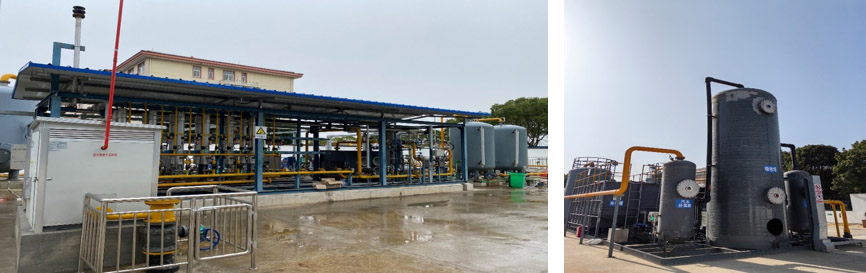
Gas Stream Dynamics in Industrial Ethanol Fermentation
Fermentation off-gas consists predominantly of carbon dioxide, typically exceeding 98% concentration by volume prior to treatment. This gas stream carries distinct residual compounds that complicate purification. Moisture levels remain saturated at operating temperatures, while trace quantities of ethanol, acetaldehyde, ethyl acetate, higher alcohols (fusel oils), and sulfur compounds remain suspended within the flow.
Direct processing without adequate preprocessing damages downstream separation equipment. Desiccant beds become fouled by heavy organics, and separation membranes suffer selectivity loss when exposed to condensed volatile organic compounds (VOCs). Designing gas treatment systems within bio-ethanol projects requires continuous, multi-stage condensate removal and scrubbing operations to protect downstream components.
Saturated Water Vapor: Causes condensation within transport pipes and leads to mechanical wear inside gas compressors.
Ethanol Vapors: Entrained ethanol droplets represent yield loss and pollute downstream carbon absorption beds.
Oxygen Contamination: Ingress during batch vessel switching complicates liquefied carbon dioxide purification processes.
Volatile Organic Compounds: Aldehydes and esters cause odors and degrade polymer membranes used in downstream separation.
Anaerobic Digestion Integration for Stillage Management
The distillation phase yields significant volumes of high-strength liquid waste, commonly referred to as thin stillage or spent wash. This effluent contains heavy chemical oxygen demand (COD) and total suspended solids (TSS). Direct discharge poses severe environmental operational issues, making internal treatment necessary for facility compliance.
Implementing high-rate anaerobic digestion systems converts spent stillage into a rich biogas stream containing 55% to 65% methane, alongside carbon dioxide, hydrogen sulfide ($H_2S$), and siloxanes. This process reduces the organic loading of wastewater while supplying a continuous methane stream that can replace natural gas inside facility boilers or undergo upgrading to renewable natural gas (RNG).
Integrating biogas upgrading units within bio-ethanol projects demands steady-state management. Fluctuations in organic loading rates within the digester alter gas production rates and gas composition, requiring flexible upgrading systems capable of operating under dynamic pressure and flow conditions.
Advanced Upgrading Technologies for Fermentation Gas and Biogas
Selecting an appropriate separation technology depends directly on the target purity, raw gas composition, and plant capacity. Biorefineries utilize three primary separation pathways for gas purification: chemical absorption, physical adsorption, and polymeric membrane separation.
1. Chemical Absorption (Amine Scrubbing)
Amine-based liquid scrubbing systems utilize aqueous solutions of alkanolamines (such as monoethanolamine or methyldiethanolamine) to selectively react with carbon dioxide molecules. The gas stream passes upward through a packed column while the amine solvent flows downward, absorbing carbon dioxide through an exothermic chemical reaction.
This process achieves high methane recovery levels (exceeding 99.5%) when applied to anaerobic digestion biogas, with minimal methane loss in the exhaust stream. The rich amine solution travels to a stripper column where thermal energy breaks the chemical bonds, releasing high-purity biogenic carbon dioxide gas while regenerating the solvent for continuous recirculation.
2. Polymeric Membrane Separation
Membrane separation relies on selective permeability through hollow-fiber polymer structures. Smaller gas molecules with high solubility, such as carbon dioxide and water vapor, permeate through the membrane walls rapidly. Larger or less soluble molecules, like methane, remain inside the fiber bore at elevated pressures.
Multi-stage membrane configurations process raw biogas without consuming liquid chemicals or requiring complex water disposal channels. High pressure differentials drive the separation process, requiring robust multi-stage screw or reciprocating gas compressors constructed from stainless steel alloys to handle moist, acidic environments.
3. Pressure Swing Adsorption (PSA)
Pressure Swing Adsorption uses synthetic zeolites or activated carbon beds to separate gas molecules based on molecular size and structural affinity under pressure. Carbon dioxide, water, and trace contaminants bind to the adsorbent bed, allowing purified methane to pass through. Once saturated, the vessel depressurizes, releasing the adsorbed molecules into an off-gas stream.
PSA systems operate on automated cyclic sequences across multiple parallel columns. Effective continuous gas pretreatment—specifically absolute water removal and hydrogen sulfide removal—is mandatory to prevent physical degradation of the adsorbent media over operating life cycles.
Engineering Considerations for System Integration
Retrofitting upgrading hardware into existing bio-ethanol projects or designing greenfield installations demands systematic process integration to ensure reliable operation without causing pressure fluctuations inside upstream fermenters.
Fermentation vessels operate under low positive pressure to prevent atmospheric oxygen ingress while avoiding physical stress on tank structures. Connecting direct gas extraction systems introduces the potential for vacuum formation or excessive backpressure. Implementing active pressure decoupling headers featuring automated blow-off valves and variable-frequency blower systems isolates vessel pressure control from gas purification demand changes.
Moisture and Condensate Management: Multi-stage cooling coils drop gas temperatures to 4°C, dropping out bulk moisture prior to entering desiccant adsorption systems.
Hydrogen Sulfide Removal: Biological desulfurization or solid-media iron sponge beds lower $H_2S$ concentrations below 10 ppm to protect compressors and membranes from acid corrosion.
Gas Compression Systems: Oil-free or oil-flooded compressor designs with downstream coalescing filters prevent lubricant contamination of separation media.
Biogenic CO2 Liquefaction: Purified carbon dioxide undergoes multi-stage compression, cryogenic cooling, and non-condensable gas stripping to achieve liquid purity suitable for industrial or food-grade distribution.
Overcoming Operational Challenges in Biorefinery Gas Recovery
Continuous operations demand high mechanical availability. Gas processing units running alongside fermentation processes must accommodate maintenance schedules and sudden feed variations driven by plant operations.
Trace organic compounds represent a continuous challenge in ethanol off-gas processing. Acetaldehyde and short-chain organic acids can pass through standard water scrubbers and accumulate on desiccant beds or membrane surfaces. Deploying regenerative thermal oxidizers (RTOs) or dual-bed active carbon polishers ahead of primary separation equipment extends component life and maintains steady gas purity metrics.
System instrumentation must feature automated analytical equipment. Continuous non-dispersive infrared (NDIR) sensors, paramagnetic oxygen analyzers, and gas chromatography units continuously monitor stream purity. Automatic divert valves isolate non-compliant gas streams instantly, returning off-spec gas to safe handling systems or flare stacks to prevent contamination of downstream storage containers or injection networks.
Initiate a Engineering Evaluation for Your Facility
Maximizing the output of gas recovery units requires customized engineering evaluations based on accurate flow rates, chemical composition testing, and facility layout constraints. Custom-designed gas upgrading equipment bridges the gap between raw fermentation emissions and commercial biogenic gas delivery.
Our team of gas processing specialists designs, manufactures, and integrates custom biogas upgrading and carbon dioxide recovery plants built for demanding industrial applications. Contact our engineering division today to submit your project specifications, request a gas stream analysis, or schedule a formal inquiry regarding gas upgrading implementation for your site.
Frequently Asked Questions
Q1: What is the typical purity of carbon dioxide generated directly from bio-ethanol projects?
A1: Raw carbon dioxide gas leaving ethanol fermentation vessels typically exhibits a concentration of 98% to 99% on a dry basis. However, it remains fully saturated with moisture and carries residual volatile organic compounds including ethanol, aldehydes, fusel oils, and trace sulfur compounds that require specialized purification before use.
Q2: Why is moisture removal a key step prior to membrane separation?
A2: Water vapor condenses when gas undergoes compression and cooling phases. Liquids present inside high-pressure membrane modules cause localized swelling, physical degradation, and rapid loss of gas separation selectivity. Dehydration using refrigeration and desiccant dryers lowers the pressure dew point to -60°C to protect these components.
Q3: Can thin stillage from ethanol production be processed without anaerobic digestion?
A3: Thin stillage can be concentrated using mechanical evaporators to produce condensed distillers solubles. However, this process consumes significant thermal energy. Implementing anaerobic digestion converts the heavy organic load inside thin stillage into renewable biogas, recovering usable energy while simplifying wastewater treatment.
Q4: How does amine scrubbing handle oxygen contamination in raw gas?
A4: Amine solvents selectively react with acidic gases like carbon dioxide and hydrogen sulfide through chemical bonding, meaning oxygen passes through the liquid absorber without reacting. However, sustained high oxygen concentrations increase solvent degradation over time, making oxygen control during batch vessel operation highly recommended.
Q5: What instrumentation is required to ensure injection-grade gas purity?
A5: Modern installations use online gas chromatography, laser-based moisture analyzers, paramagnetic oxygen sensors, and non-dispersive infrared gas detectors. These instruments measure carbon dioxide, methane, oxygen, hydrogen sulfide, and water dew points continuously, triggering automated divert valves if parameters exceed operational limits.