


News
We'll get back to you as soon as possible.
Arundo Donax Biogas: High-Yield Biomass & Advanced Upgrading Solutions
When looking for a non-food, high-yield feedstock for biomethane, arundo donax biogas stands out. This giant reed grows fast on marginal land, needs little nitrogen, and produces up to 40 tons of dry biomass per hectare. But raw arundo donax biogas projects often face slow digestion and low gas yields. The solution lies in combining steam explosion pretreatment with membrane-based upgrading equipment. Below, we walk through why this feedstock works and how modern plants get the most out of crop.
Why Arundo Donax Beats Corn Silage for Biogas Production
Arundo donax biogas systems start with a crop that has clear advantages. Unlike corn, Arundo donax does not compete with food production. It grows on degraded or saline soils, and its rhizomes store energy over winter. Many operators have switched from maize to this reed because harvesting costs are lower. The plant gives high lignocellulose content, which used to be a problem, but new pretreatment methods now turn that into an asset.
Farmers in Southern Europe and California have reported dry matter yields of 35–45 t/ha/year. That output is nearly double what switchgrass delivers. With those volumes, arundo donax biogas plants can run year-round without storing large silage volumes. Also, the fibrous structure creates stable digestion beds, reducing scum layer formation in continuous stirred-tank reactors (CSTRs).
Steam Explosion: The Game Changer for Arundo Donax Biogas
Raw Arundo donax has tough lignin wrapping around cellulose. Microbes struggle to break it down in standard digesters. This is where steam explosion comes into play. High-pressure steam (around 200°C) is suddenly released, shattering the fibre structure. The exploded material becomes a water-miscible slurry, with no floating layers or bridging.
One equipment provider, OPM, offers a powerful steam explosion reactor that shortens anaerobic fermentation from 28–60 days to just 3–7 days. For arundo donax biogas projects, that means you can reduce the digester volume by 90%. An existing 10,000 m³ tank can be replaced with a 1,000 m³ unit while keeping the same gas output. Lower capital costs and faster throughput make the crop economical even on a small scale.
Membrane Separation: Upgrading Arundo Donax Biogas to Pipeline Grade
Raw arundo donax biogas typically contains 50-55% methane, 45-50% CO₂, and trace H₂S. To inject into natural gas grids or use as vehicle fuel, methane concentration must exceed 96%. Membrane technology achieves this with low energy input. The gas is passed through hollow-fibre membranes that selectively retain methane while CO₂ permeates out.
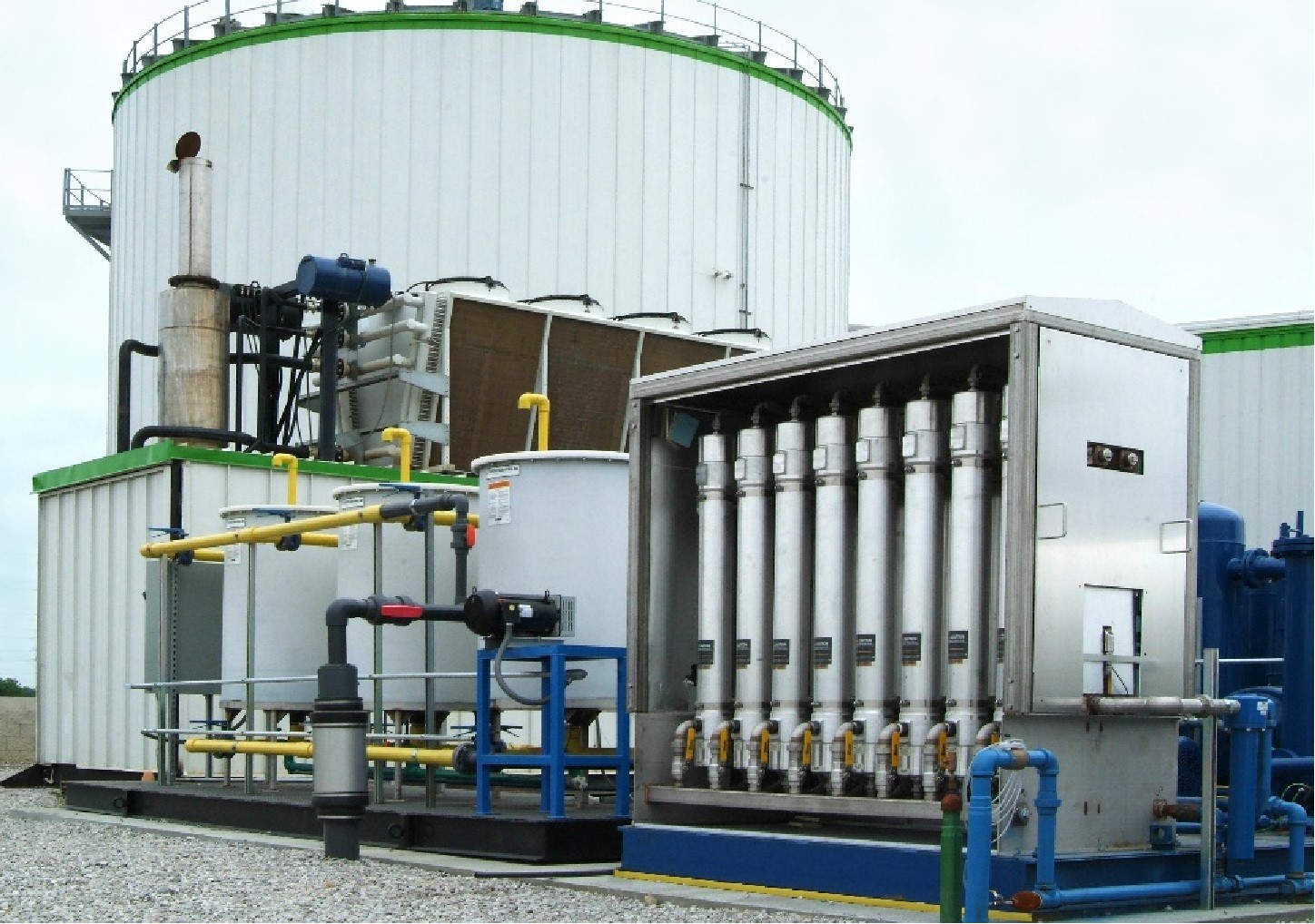
Modern three-stage membrane systems from OPM include H₂S removal and fit into a 40-foot container. Final CO₂ content stays below 2%, and methane loss is under 0.5%. When you process arundo donax biogas with such a unit, you can also add CO₂ liquefaction. Liquid CO₂ becomes an extra revenue stream, improving the carbon intensity score for renewable fuel credits.
Integrated Process: From Giant Reed to Compressed Biomethane
A complete arundo donax biogas plant using OPM equipment follows four steps. First, harvesting and milling: the straw-oriented pellet mill reduces 30-50mm stalks to 2-3mm particles. This step alone raises biogas harvest by 11%, as surface area for enzymes increases. Second, steam explosion at 160-200°C for 15 minutes, then explosive decompression. Third, anaerobic digestion in a small CSTR (only 10% of conventional size). Fourth, membrane upgrading to 98% methane.
OPM has built over 150 turnkey projects globally, though mostly for wood and agricultural residues. Their gearbox technology, originally designed for wind turbines, gives a 15-year lifespan with near-zero bearing maintenance. For arundo donax biogas operators, reliability matters because downtime costs revenue from green certificates and gas sales.
Cost Savings and Carbon Benefits of Arundo Donax Biogas
Let’s talk numbers. A conventional corn silage biogas plant might need 2,000 m³ digester for 500 m³/h raw gas output. With arundo donax biogas and steam explosion, the same output comes from a 200 m³ digester. Civil works, heating, and mixing costs drop dramatically. Also, because the exploded slurry is below 50°C before entering the digester, you save cooling energy.
On the carbon side, Arundo donax stores carbon in its roots, building soil organic matter. The upgraded biomethane replaces fossil natural gas, cutting net emissions by 110% compared to diesel. Many European projects get double carbon credits: one for renewable fuel and one for carbon sequestration. That’s why investment in arundo donax biogas lines has jumped by 35% in the last two years.
Overcoming Common Hurdles in Commercial Arundo Donax Biogas Plants
Some operators worry about Arundo donax becoming invasive. However, modern sterile cultivars (like 'Cwrt' and 'NuPo') produce no viable seeds. Rhizome barriers control spread effectively. Others fear high silica content damaging pumps. The steam explosion actually softens the silica, and OPM’s pellet mills use hardened alloys that resist abrasion. After processing, the digestate is a high-quality fertiliser, low in pathogens and weed seeds.
For arundo donax biogas to work at scale, you must integrate all stages from harvest to upgrading. Isolated units lead to bottlenecks. For example, if the steam reactor is oversized but the membrane unit is undersized, CO₂ content stays high. That’s why turnkey providers like OPM deliver matched systems, including the option for a mobile containerised upgrading plant that can be moved across multiple farms.
Future Outlook: Arundo Donax Biogas in a Low-Carbon Economy
Europe's revised Renewable Energy Directive (RED III) targets 42.5% renewable energy in transport by 2030. Arundo donax biogas fits perfectly because it yields advanced biofuel that does not compete with food. The US Inflation Reduction Act offers additional credits for cellulosic biomethane. As gas prices remain volatile, on-farm production becomes a hedge. Membrane technology has improved so much that small-scale arundo donax biogas units (100 m³/h raw gas) are now profitable without subsidies, provided you get the pretreatment right.
In summary, arundo donax biogas is not a niche crop anymore. With modern steam explosion and membrane separation, it beats traditional feedstocks on both yield and economics. Operators who adopt integrated OPM systems cut digester size by 90%, fermentation time from 60 days down to 3 days, and reach pipeline-grade methane with less than 2% CO₂. The future of biogas belongs to high-solids, lignocellulosic crops, and Arundo donax leads the pack. See how arundo donax biogas can transform your farm or waste management facility today.
Frequently Asked Questions about Arundo Donax Biogas Production
Q1: Is Arundo donax really better than corn or grass for
biogas?
A1: Yes, for several reasons. Arundo donax
gives twice the dry biomass per hectare (40 vs 20 t/ha), grows on poor soils,
and needs no fertiliser. After steam explosion, its methane yield per ton
matches corn silage, but without the food vs fuel debate. Long-term trials show
arundo donax biogas plants run 20% cheaper than corn-based ones
because of lower input and digester costs.
Q2: Do I need special equipment to process Arundo
donax?
A2: You do. Standard choppers and digesters
will struggle with its fibrous stalks and high lignin. However, a steam
explosion reactor (like OPM’s unit) breaks down lignin effectively.
Additionally, a slow-speed pellet mill designed for 30% moisture straw reduces
particle size without clogging. Many suppliers now offer arundo donax
biogas packages that include milling, steam treatment, and membrane
upgrading.
Q3: How long does anaerobic digestion take for exploded Arundo
donax?
A3: After steam explosion, fermentation time
drops dramatically. Conventional digestion of raw Arundo donax takes 50–70 days.
With OPM’s steam explosion reactor, the treated material degrades in just 3 to 7
days. That means your digester turns over 10 times faster, so you produce the
same amount of arundo donax biogas with a much smaller
tank.
Q4: Can I use membrane upgrading for both landfill gas and Arundo
donax biogas?
A4: Absolutely. Membrane separators
work on any biogas source. For landfill gas, providers like OPM combine membrane
with PSA (pressure swing adsorption) to handle higher oxygen and nitrogen
content. For pure arundo donax biogas, three-stage membrane
units remove H₂S and CO₂ in a single container, giving final methane above 98%.
Both options can add CO₂ liquefaction for extra income.
Q5: What is the payback period for an Arundo donax biogas upgrading
plant?
A5: Payback depends on scale and local gas
prices. For a 500 m³/h raw gas system (around 300 kW thermal output), payback is
typically 3.5 to 5 years in Europe, given current gas prices and green
certificates. The fast payback is due to the low digester investment (90%
smaller) and high methane yield. In regions with carbon credits, payback can
drop to 2–3 years for arundo donax biogas facilities.