


News
We'll get back to you as soon as possible.
Industrial Engineering and Gas Purification Standards for POME Biogas Plants
Palm oil extraction generates high-strength liquid waste known as Palm Oil Mill Effluent (POME). Processing fresh fruit bunches (FFB) leaves behind an acidic, hot, and organically dense wastewater stream that requires sophisticated biological treatment. Left untreated, POME releases substantial volumes of fugitive methane directly into the atmosphere through open-pond decomposition. Converting this substrate into industrial-grade biomethane or compressed bio-methane (Bio-CNG) requires specialized biochemical equipment and high-efficiency purification systems. Contemporary pome biogas plants transform this industrial effluent from an environmental liability into a predictable source of pipeline-quality fuel and grid power.
POME Physicochemical Properties and Biochemical Dynamics
The raw effluent leaving the clarification and sterilization sections of a palm oil mill exhibits extreme characteristics compared to typical municipal or agricultural slurries. Raw POME discharges at temperatures between 80°C and 90°C, carrying high concentrations of suspended organic fragments, plant cells, and residual emulsified oils.
Chemical Oxygen Demand (COD): 50,000 to 105,000 mg/L
Biochemical Oxygen Demand (BOD₅): 25,000 to 55,000 mg/L
Total Suspended Solids (TSS): 20,000 to 45,000 mg/L
Oil and Grease (O&G): 4,000 to 12,000 mg/L
Raw Effluent pH: 4.0 to 4.8
Total Nitrogen (TN): 750 to 1,500 mg/L
The high organic fraction makes POME suitable for continuous methanogenesis, with biochemical methane potential (BMP) figures ranging from 28 to 34 Nm³ of raw biogas per metric ton of raw POME processed. The high grease concentration introduces long-chain fatty acids (LCFAs) during hydrolysis. These LCFAs adhere to microbial cell walls and hinder mass transport inside the anaerobic digester, requiring reliable physical separation steps prior to biological digestion.
Primary Feedstock Conditioning and Pre-Treatment Systems
POME requires thermal and physical conditioning before entering anaerobic reactors. Because methanogenic archaea exhibit high sensitivity to sudden temperature swings, the incoming stream must be cooled from sterilization temperatures down to operational mesophilic (38°C to 42°C) or thermophilic (52°C to 55°C) setpoints. Wide-gap plate heat exchangers or spiral heat exchangers recover thermal energy, transferring it to boiler feedwater circuits while bringing the wastewater to the target incubation temperature.
De-oiling centrifuges and automated rotary drum screens extract coarse fibers and residual decanter solids. Following fiber extraction, dissolved air flotation (DAF) or mechanical skimmers reduce the free oil and grease volume below 1,500 mg/L. This pre-treatment step shields methanogenic populations from mass-transfer limitations and prevents the formation of thick, impenetrable scum crusts across the reactor surface.
Anaerobic Digester Architectures in POME Biogas Plants
Selecting the appropriate reactor configuration governs hydraulic throughput, solids decomposition rates, and long-term operating reliability. Industrial pome biogas plants use two main reactor layouts based on available site footprint and process targets.
Covered Anaerobic Lagoons (CAL)
Covered lagoons use deep earth-bank basins sealed with thick high-density polyethylene (HDPE) geomembranes (typically 1.5 mm to 2.0 mm thick). These systems feature extensive footprints and operate with long hydraulic retention times (HRTs) spanning 30 to 60 days. Low internal fluid velocity allows passive sedimentation of heavy grit and suspended solids. While capital deployment for basin construction remains low, covered lagoons exhibit lower volumetric loading rates (1.0 to 2.5 kg COD/m³/day) and face accumulation of settled recalcitrant sludge, which eventually requires offline dredging.
Continuously Stirred Tank Reactors (CSTR)
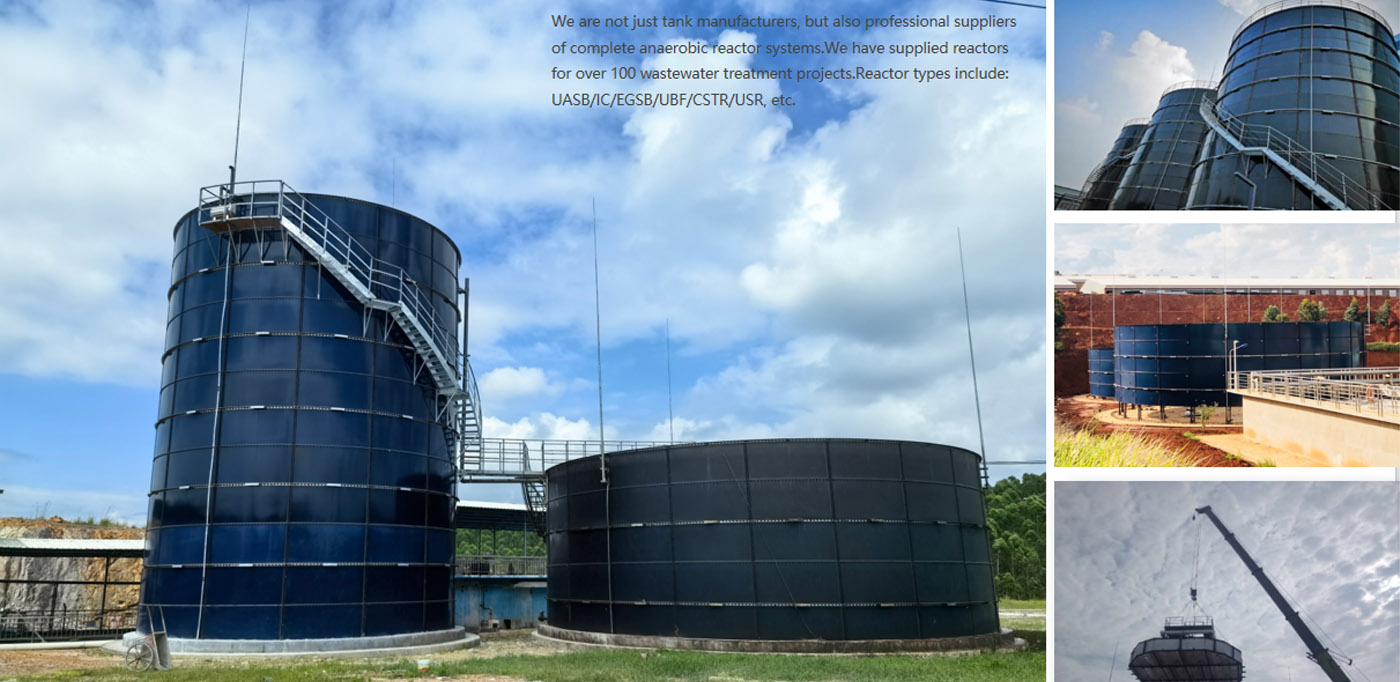
Vertical glass-fused-to-steel or epoxy-coated concrete CSTR units deliver controlled mixing conditions. Operating with volumetric organic loading rates (OLRs) of 4.5 to 8.0 kg COD/m³/day, CSTR installations reduce the required hydraulic retention time to between 15 and 22 days. Submerged mechanical draft-tube mixers or external hydraulic recirculation loops maintain uniform biological contact, distribute volatile fatty acids (VFAs) evenly, and maintain uniform operating temperatures. Built-in sediment purge valves and upper scum removal rings address sludge sedimentation and grease accumulation without requiring plant shutdowns.
Biochemical Stability and Process Control Indicators
Operating high-rate digesters on complex POME feeds requires continuous monitoring of volatile fatty acids relative to total buffer capacity. The process involves four concurrent bacterial transformations:
Hydrolysis: Complex carbohydrates, proteins, and lipids break down into soluble monomers, sugars, and long-chain fatty acids.
Acidogenesis: Fermentative bacteria convert soluble products into volatile fatty acids (acetic, propionic, butyric acids), alcohols, carbon dioxide, and hydrogen.
Acetogenesis: Acetogenic microbes convert volatile acids and alcohols into acetate, hydrogen gas, and carbon dioxide.
Methanogenesis: Acetotrophic and hydrogenotrophic archaea transform acetate and hydrogen/carbon dioxide into methane.
The operational balance hinges on maintaining the ratio of volatile fatty acids to total inorganic carbon (FOS/TAC or VFA/Alkalinity) below 0.30. Should the ratio climb past 0.40, methanogenesis slows, leading to propionic acid accumulation, dropping pH, and souring the digester. Because POME provides inherent bicarbonate alkalinity once nitrogenous compounds break down, stable operation maintains internal pH between 7.2 and 7.8 without ongoing caustic chemical dosing.
Gas Conditioning and Deep Desulfurization for POME Biogas Plants
Due to the frequent use of sulfuric acid in palm oil processing and high indigenous organic sulfur content, the biogas generated by pome biogas plants carries elevated hydrogen sulfide levels, typically between 1,500 and 4,500 ppmv. Direct utilization in high-speed reciprocating engines or membrane upgrading skids requires extensive desulfurization and moisture separation.
Biological Trickling Desulfurization (BTF)
Biological trickling filters serve as the primary bulk desulfurization step. Raw gas flows counter-currently or co-currently through packed plastic media colonized by sulfur-oxidizing bacteria such as Thiobacillus. Supplying small amounts of atmospheric oxygen (2% to 4% by volume) enables these microbes to convert hydrogen sulfide into elemental sulfur and sulfates. A regulated water spray washes away accumulated sulfates, keeping H₂S concentrations in the outlet gas below 150 to 200 ppmv while eliminating the need for expensive chemical inputs.
Dry Scavenger and Chemical Polishing
Downstream membrane systems require near-total hydrogen sulfide removal. Secondary polishing uses regenerative or disposable iron sponge and extruded metal oxide pellets. Passing the bulk-treated gas through fixed-bed media units removes remaining traces, lowering H₂S down to under 2 ppmv. This step prevents mechanical erosion in gas compression equipment and stops irreversible active layer poisoning in selective separation membranes.
Membrane Separation and High-Purity Upgrading
Purifying clean biogas into biomethane requires separating carbon dioxide ($CO_2$) from methane ($CH_4$). Multi-stage polymeric membrane separation provides the most operational flexibility for remote agro-industrial sites. Hollow-fiber membranes constructed from polyimide or polysulfone polymers utilize differences in gas permeation rates to separate gas species.
Carbon dioxide, water vapor, and remaining hydrogen sulfide qualify as "fast gases," permeating rapidly through the selective polymer walls under pressure. Methane acts as a "slow gas," remaining within the hollow-fiber core and discharging at the high-pressure retentate side. Modern pome biogas plants employ three-stage membrane topologies:
Stage 1: Performs the bulk bulk separation of $CH_4$ and $CO_2$ from the compressed feed gas (operating at 12 to 16 barg).
Stage 2: Polishes the retentate stream from the primary stage, elevating methane purity up to 97.0% - 99.0% by volume.
Stage 3: Reprocesses the permeate from Stage 1 and Stage 2 to extract residual methane. This stream recycles directly back to the main gas compressor inlet, driving overall methane recovery rates above 99.2% and keeping methane slip below 0.8% in the off-gas exhaust.
Quality Specifications and Product Distribution Channels
Purified biomethane derived from pome biogas plants must satisfy stringent quality standards before entering industrial distribution chains. Whether injected into regional gas pipelines or compressed into transportable storage vessels, the refined gas must meet strict analytical baselines:
Methane ($CH_4$): ≥ 96.0% to 98.5% by volume
Carbon Dioxide ($CO_2$): ≤ 2.0% to 3.0% by volume
Oxygen ($O_2$): ≤ 0.2% by volume
Hydrogen Sulfide ($H_2S$): ≤ 5 mg/Nm³
Moisture Dew Point: Below -40°C at pipeline pressures
Gross Wobbe Index: 48.0 to 52.5 MJ/Nm³
Because palm oil mills operate in rural areas far from established pipeline grids, virtual pipeline distribution serves as the primary route to market. Multi-stage high-pressure compressors step up the refined biomethane pressure to 250 barg. The compressed fuel (Bio-CNG) feeds into high-strength Type I steel or Type IV composite cylinder cascades mounted on truck-drawn tube trailers. These mobile units haul clean vehicle fuel directly to off-grid industrial hubs, diesel-replacement vehicle fleets, and power generation substations.
Industrial Facility Engineering and Turnkey Deployment
Deploying an industrial biogas facility requires matching wastewater pretreatment mechanics, anaerobic digestion systems, and membrane gas separation modules to each mill's processing volume. Balancing fluctuating seasonal FFB milling rates with consistent gas production demands precise instrumentation, robust mixing, and dependable purification controls.
We deliver comprehensive biogas engineering solutions, high-durability CSTR systems, and specialized membrane gas upgrading equipment built specifically for complex agro-industrial waste streams. Submit a commercial project inquiry to our engineering team to review site specifications, mass-balance calculations, and system integration layouts.
Frequently Asked Questions
Q1: What is the typical biogas yield generated per metric ton of
POME?
A1: Processing one metric ton of fresh POME yields an average
of 28 to 34 Nm³ of raw biogas. The precise output depends on upstream milling
efficiency, water addition rates, and the residual concentration of volatile
solids and emulsified oils.
Q2: Why is raw POME cooled before entering the anaerobic
digester?
A2: POME leaves milling processes at temperatures between
80°C and 90°C. These high temperatures denature microbial enzymes and inhibit
the bacteria responsible for anaerobic digestion. Heat exchangers lower the
incoming wastewater to mesophilic (38°C to 42°C) or thermophilic (52°C to 55°C)
setpoints to ensure stable methanogenesis.
Q3: How do operators address high hydrogen sulfide levels in
POME-derived biogas?
A3: Facilities use a multi-stage approach.
First, biological trickling filters utilize sulfur-oxidizing bacteria to remove
90% to 95% of the bulk $H_2S$. Downstream dry desulfurization vessels loaded
with iron oxide or specialized metal scavengers then scrub the remaining sulfide
down to under 2 ppmv, protecting downstream upgrading equipment.
Q4: What makes CSTR reactors preferable to covered lagoons for
certain installations?
A4: CSTR systems offer smaller physical
footprints, precise mechanical agitation, uniform temperature maintenance, and
automated grit removal. They operate at higher organic loading rates with
shorter retention times, making them suitable for sites with limited land or
strict environmental controls.
Q5: What methane recovery levels do modern membrane separation
systems deliver?
A5: Multi-stage polymeric membrane systems with
permeate recycle loops routinely achieve methane recovery rates exceeding 99%.
This efficiency keeps methane slip to the off-gas stream below 1%, ensuring full
compliance with strict environmental emissions standards while delivering
biomethane with over 97% purity.