


News
We'll get back to you as soon as possible.
5 Core Engineering Principles of Water Scrubbing for Biogas Upgrading
Biogas synthesized via anaerobic digestion contains primarily methane (CH4, 50-70%) and carbon dioxide (CO2, 30-50%), alongside trace impurities such as hydrogen sulfide (H2S), moisture, and volatile organic compounds. Converting this raw fuel into grid-compliant renewable natural gas (RNG) or bio-CNG requires the selective separation of carbon dioxide to elevate the calorific value and stabilize the Wobbe Index. Among industrial physical separation methodologies, water scrubbing for biogas upgrading represents the most widely deployed process globally, utilizing the differential solubility of gases in an aqueous phase governed by Henry's law.
The operational framework relies purely on physical gas-liquid absorption, eliminating the necessity for costly proprietary chemical solvents or recurring consumable reagents. Carbon dioxide exhibits an aqueous solubility roughly 26 times higher than that of methane at standard processing temperatures (10°C to 20°C). By introducing pressurized raw biogas into a counter-current packed absorption column, water captures CO2 molecules while permitting methane gas to discharge through the column top at high purity levels.
Thermodynamics and Phase Equilibrium Fundamentals
The operational efficiency of a physical absorption system hinges on thermodynamic equilibrium at the gas-liquid interface. Henry’s Law defines the relationship between the equilibrium concentration of dissolved gas ($C$) and its partial pressure ($p$) above the liquid:
C = H(T) × p
Here, the Henry's law solubility constant $H(T)$ demonstrates an inverse temperature dependency; lower water temperatures yield higher CO2 absorption coefficients. Operating the absorption column between 5°C and 12°C maximizes solvent capacity, reducing the required volumetric flow rate of process water. Maintaining stable absorption parameters prevents methane loss in the aqueous stream, safeguarding process efficiency.
Raw gas enters the base of the column under regulated operational pressures between 6 and 10 bar gauge (bar(g)). Pressurization increases the partial pressure of carbon dioxide, driving mass transfer across the two-phase boundary layer into the descending liquid film. The engineered design balances pressure and liquid flow to avoid oversaturating the liquid before it reaches the discharge sump.
Core Architectural Components of Modern Systems
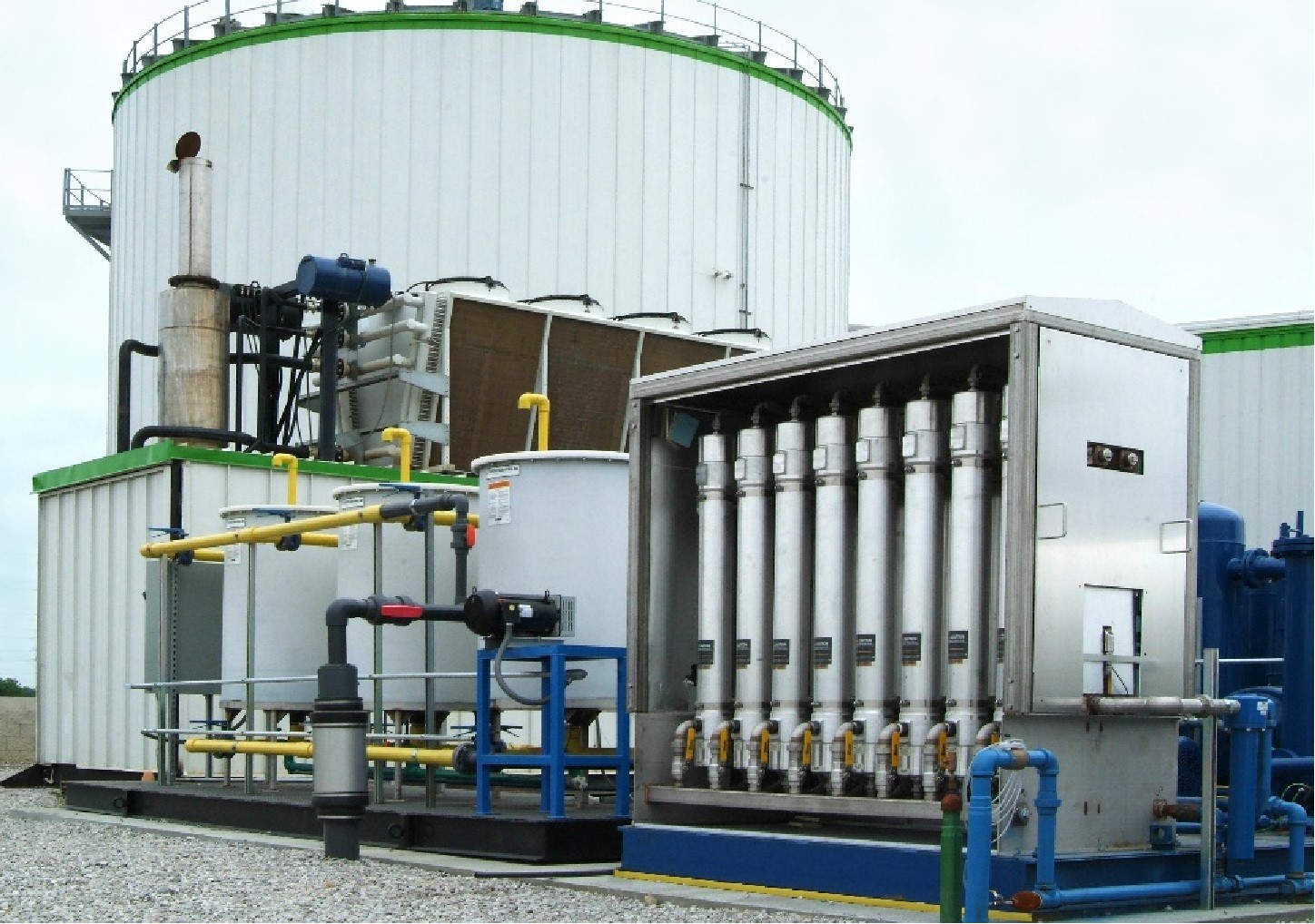
Industrial execution of water scrubbing for biogas upgrading incorporates several interdependent process units arranged to ensure continuous gas throughput, solvent regeneration, and minimal methane slip.
Raw Gas Compression Train: Multistage reciprocating or oil-injected rotary screw compressors elevate incoming raw biogas from atmospheric digester pressure to the required system operating pressure (typically 7 to 9 bar(g)). Integrated intercoolers remove compression heat, reducing gas temperatures prior to absorption.
Absorption Column (Absorber): A vertical pressure vessel packed with structured or random packing (such as polypropylene Pall rings or ceramic saddles). Packing media provides high specific surface areas (150 to 350 m²/m³) to facilitate thin water film formation and extended phase contact time.
Flash Vessel: Water exiting the absorber contains dissolved carbon dioxide along with minor fractions of co-absorbed methane. Flashing this liquid stream down to an intermediate pressure (typically 2 to 3 bar(g)) causes methane—which has a much lower solubility constant—to desorb rapidly into the gas phase. This flash gas is recycled directly back to the raw gas compressor inlet, recovering virtually all liberated hydrocarbons.
Stripping (Desorption) Column: The flash vessel bottoms stream expands to atmospheric conditions within a dedicated regeneration column. Air is blown counter-currently upward through the tower, stripping the dissolved CO2 from the water phase and venting it into the atmosphere. The regenerated water is subsequently pumped back to the absorption tower.
Biomethane Drying Unit: The upgraded gas leaving the top of the absorber reaches saturated relative humidity at operating pressure. A dual-column thermal-swing or pressure-swing adsorption (TSA/PSA) system containing molecular sieves extracts water molecules, yielding pipeline-spec dew points below -60°C.
Mass Transfer Dynamics and Column Internals
Gas-liquid mass transfer rates dictate the overall diameter and packing height requirements of the absorption column. The total transfer rate depends directly on the overall mass transfer coefficient ($K_L a$) and the logarithmic mean concentration difference between the gas and liquid streams.
Liquid redistribution represents a major factor in absorption tower performance. Fluid descending through thousands of packing units tends to migrate outward toward the vessel shell walls, creating an uneven liquid-to-gas ($L/G$) ratio across the column cross-section. Specialized liquid distributors installed at 3- to 4-meter bed height intervals re-center the aqueous stream, mitigating channeling phenomena that compromise gas separation efficiency.
High liquid viscosity or excessive suspended solids lower mass transfer rates and increase column pressure drop. Implementing inline filtration systems that extract suspended matter down to 5 microns preserves low operating differential pressures and prevents biological fouling of packing matrices.
Process Configuration: Regenerative vs. Once-Through Systems
Engineering configurations for water scrubbing for biogas upgrading split into two distinct operational paradigms based on regional water availability and site-specific operational layouts.
Closed-Loop Regenerative Water Scrubbing
Closed-loop plants circulate the solvent continuously between the absorption column and the air stripper. Regenerative designs incorporate continuous water cooling via heat exchangers to counter ambient heating and friction-induced energy transfers from high-pressure pumps. Because process water loops repeatedly, continuous biocide dosing or ultraviolet sterilization modules are deployed to prevent bacterial buildup and biofilm fouling on internal packing elements.
Once-Through (Open-Loop) Water Scrubbing
Municipal wastewater treatment facilities often produce large volumes of treated final effluent. Open-loop systems harness this treated effluent directly as an absorption medium, pumping it once through the absorption vessel before discharging it back into the plant's main discharge line or outfall. This method completely eliminates the stripping tower, blowers, and regeneration power requirements. Dissolved carbon dioxide departs within the bulk wastewater stream without entering atmospheric gas phases at the plant footprint.
Contaminant Processing and Gas Conditioning
Raw biogas contains multiple contaminants that require precise management within the water scrubbing flow path to avoid mechanical degradation and preserve product gas purity.
Hydrogen Sulfide (H2S) Management
H2S exhibits strong water solubility, co-absorbing alongside carbon dioxide in the primary tower. In closed-loop systems, stripping this dissolved sulfide with ambient air prompts biological oxidation by autotrophic bacteria, generating elemental sulfur ($S^0$) or sulfuric acid ($H_2SO_4$). Solid sulfur deposits foul stripping tower internals, while sulfuric acid depresses water pH, inducing corrosion across carbon-steel components. Therefore, industrial plants deploy primary rough desulfurization upstream via biological trickling filters, activated carbon beds, or chemical scavengers to maintain raw gas H2S concentrations below 100 ppm prior to compression.
Moisture and Dew Point Control
While passing through the water column, methane achieves relative humidity. Dew point suppression demands robust downstream engineering. Upgraded wet biomethane passes through a mechanical coalescing demister, followed by a chilled-water heat exchanger that condenses the bulk water content at 3°C to 4°C. The chilled gas then streams through regenerative desiccant beds loaded with 3A/4A zeolite molecular sieves, reducing water content below 32 mg/Nm³ to align with standard pipeline transmission rules.
Comparative Operational Parameters
Evaluating absorption processes requires examining core operational variables across varied operating parameters. The following data highlights the baseline parameters found in standard closed-loop water scrubbing units:
| Parameter | Operating Value Range | Engineering Impact |
|---|---|---|
| Operating Pressure | 6.0 – 10.0 bar(g) | Drives CO2 solubility via partial pressure increase |
| Water Temperature | 6 – 15 °C | Controls Henry’s constant; lower temps reduce solvent demand |
| Liquid-to-Gas ($L/G$) Ratio | 0.15 – 0.25 m³ water / Nm³ gas | Determines pumping horsepower and column cross-section |
| Methane Recovery | 98.0% – 99.5% | Directly influenced by flash vessel recovery pressure |
| Product Methane Content | 96.5% – 99.0% | Governed by packing bed height and liquid balance |
System Integration and Grid Injection Specifications
Biomethane derived from water scrubbing for biogas upgrading must routinely meet rigorous pipeline transmission standards before direct distribution network injection. These specifications include maintaining methane concentrations above 96%, total inert gases (CO2 + N2) below 3-4%, and oxygen concentrations below 0.2% by volume.
During the stripping phase in closed-loop systems, water absorbs small volumes of dissolved nitrogen and oxygen from the stripping air. When recirculated back into the absorption vessel, trace levels of these atmospheric gases transfer into the biomethane stream. Mitigating this effect requires precise airflow throttling in the stripping column to prevent nitrogen enrichment of the product biomethane. Advanced automated plants incorporate real-time gas chromatography to modulate water-to-gas ratios and stripper blower frequencies continuously, preserving gas quality regardless of digester methane fluctuations.
For installations targeting vehicular fuel applications (Bio-CNG), biomethane off-gas passes directly from the drying unit to high-pressure storage compressors operating at 200 to 250 bar(g). The inherent physical stability of water-scrubbed biomethane, paired with low trace solvent residues, protects vehicle fuel tanks and high-pressure valves from chemical degradation.
Frequently Asked Questions
Q1: How does water scrubbing handle variable methane percentages in the raw biogas supply?
A1: Modern systems integrate variable-frequency drives (VFDs) on raw gas compressors and high-pressure water circulation pumps. Automated feedback loops measure methane and carbon dioxide levels in the raw and product gas lines, adjusting the liquid-to-gas ($L/G$) ratio instantaneously. If the raw gas CO2 percentage increases, the circulation pump increases water flow over the absorption packing to maintain steady mass transfer rates.
Q2: What is the typical methane recovery rate achieved by a regenerative water scrubber?
A2: Well-engineered systems achieve methane recovery rates exceeding 99%. While small quantities of methane dissolve into the water phase inside the high-pressure column, routing the water through an intermediate flash vessel releases virtually all entrained CH4. Compressing this flash gas back into the inlet stream prevents methane slip and keeps emissions within environmental limits.
Q3: Why is hydrogen sulfide desulfurization required before raw gas enters the water scrubber?
A3: Water dissolves H2S alongside CO2. In closed-loop systems, oxygen introduced within the air stripping column oxidizes dissolved H2S into elemental sulfur and sulfuric acid. Sulfur particulates accumulate within packing voids, leading to severe clogging and pressure drops, while acidic conditions accelerate corrosion in process pipework and heat exchangers.
Q4: Can treated municipal wastewater be used directly without a regeneration loop?
A4: Yes. Once-through water scrubbing utilizes treated effluent from an adjacent municipal wastewater treatment plant. Because the water exits straight to the discharge works after a single pass through the absorber, no stripping column, flash vessel, or desorption blower system is required. This layout reduces total plant footprint and parasitic power draw.
Q5: How does ambient temperature affect the performance of water scrubbing systems?
A5: Warmer ambient conditions heat the circulating water, which lowers the solubility of carbon dioxide according to Henry's law. Without cooling, higher water temperatures demand larger pumping volumes to process the same volume of raw gas. Industrial installations typically incorporate closed-circuit evaporative cooling towers or mechanical chillers to hold process water within the optimal range of 8°C to 12°C.
Project Engineering and Technical Inquiries
Every biogas source features individual operating realities, from raw gas throughputs and trace contaminant profiles to local utility interconnection requirements. Designing a dependable plant requires specialized fluid dynamics modeling, precise column internal selection, and seamless auxiliary integration.
If your facility is evaluating the implementation of water scrubbing for biogas upgrading, connect with our process engineering division. Our engineering team conducts comprehensive gas profile assessments, process simulations, and detailed equipment layout reviews configured around your site's physical parameters. Submit your raw gas specifications and operational targets to initiate an engineering consultation today.