


News
We'll get back to you as soon as possible.
Engineering High-Solids Biomass Conversion: Operational Mechanics of the Plug Flow Anaerobic Digester
Industrial bioenergy generation relies on continuous microbiological stability, precise fluid behavior, and predictable residence kinetics. While traditional dilute slurries function predictably within continuously stirred tank reactors, high-solids waste streams present severe fluid transport and mass-transfer barriers. Adopting a plug flow anaerobic digester allows biological facilities to process dry and semi-dry substrates without extensive liquid dilution. This structural configuration accommodates total solids concentrations ranging from 15% to 30%, establishing a linear conversion gradient where hydrolytic, acidogenic, and methanogenic phases proceed sequentially along a horizontal vessel.
Transitioning from stirred architectures to plug flow regimes alters the transport physics inside the reactor. Rather than homogenizing the microbial matrix with fresh substrate, the incoming feedstock displaces the digesting volume forward in discrete packets. This continuous laminar advancement eliminates short-circuiting, guaranteeing that every mass element sustains the exact hydraulic retention time designed for complete volatile solids breakdown. The resulting biogas stream exhibits steady operational characteristics suitable for direct transmission into industrial treatment and upgrading plants.
Fundamental Rheology and Piston-Flow Kinetics
Within an industrial plug flow anaerobic digester, reactants move as a cohesive slug through a high-aspect-ratio horizontal chamber. Operating in this mode requires addressing non-Newtonian fluid rheology. Substrates characterized by dry matter concentrations above 15%—such as dairy manure containing straw bedding, crop residues, and sorted municipal bio-wastes—display pronounced yield stress and shear-thinning properties. When unagitated, the slurry resists displacement, functioning almost as a viscoelastic solid. Once sufficient forward pressure or gentle shear is applied, apparent viscosity drops, enabling uniform movement without back-mixing.
Process verification relies on the Bodenstein number and Peclet dispersion models to evaluate deviation from ideal piston displacement. An ideal system presents an infinite Peclet number, signifying absolute zero longitudinal mixing and complete transverse uniformity. In field conditions, minor axial dispersion occurs. Engineers limit this back-dispersion through internal baffle geometries and carefully configured sloped floors, maintaining an actual dispersion number below 0.1. Preventing back-mixing maintains distinct biological reaction zones: the inlet zone suppresses premature methanogenesis where volatile fatty acid generation accelerates, while the terminal zone maintains depleted organic conditions where methanogens fully exhaust residual acetate.
Mechanical Subsystems: Agitation, Internal Transport, and Heating
Maintaining operational equilibrium across a commercial plug flow anaerobic digester demands specialized mechanical infrastructure capable of managing high torque loads and aggressive abrasive wear. The components must fulfill three discrete operations simultaneously: longitudinal mass transport, crust disruption, and thermal stabilization across high-viscosity boundaries.
Low-Speed Longitudinal Mixing Assemblies
Unlike rapid vertical agitators, horizontal digesters employ massive, slowly rotating central shafts fitted with radial paddles or intermittent screw flights. Rotational speeds typically remain between 0.5 and 2.0 revolutions per minute. This minimal shear input achieves several objectives:
It breaks surface crusts formed by floating lignocellulosic fibers and hydrophobic lipids.
It forces entrapped biomethane bubbles out of the dense slurry matrix toward the headspace, preventing gas pockets from causing localized buoyancy variations.
It facilitates forward conveyance without destroying delicate syntrophic microbiological colonies clustered around particulate matter.
Thermal Distribution via Internal and Jacket Exchangers
Viscous slurries exhibit poor thermal conductivity, creating steep temperature gradients if heated solely through standard external piping circuits. Heat transfer in horizontal digesters is accomplished via heavy-gauge floor heating circuits supplemented by jacketed sidewalls or heated interior paddle shafts. Operating within either mesophilic (37°C to 40°C) or thermophilic (52°C to 55°C) bands requires continuous hot-water circulation through these submerged conduction surfaces. Accurate temperature stability within plus or minus 0.5°C is achieved by zoning the heating circuits, delivering maximum thermal energy at the inlet sector to bring cold incoming solids to equilibrium rapidly without scorching the biological boundary layer.
Feedstock Characterization and Degradation Profiles
Feedstock composition dictates hydraulic retention time (HRT), degradation kinetics, and structural resistance. Dry anaerobic digestion systems excel when processing recalcitrant or high-bulk materials that choke standard pumping and wet digestion systems.
Dairy Bedding and Manure: High fiber fractions (cellulose, hemicellulose, lignin) deliver substantial structural integrity. The digestion profile demonstrates moderate hydrolysis speeds, requiring 25 to 35 days of retention to liberate maximum biochemical methane potential (BMP).
Source-Separated Organics (SSO): Food waste and commercial kitchen materials supply elevated concentrations of readily fermentable sugars, proteins, and free lipids. These inputs trigger rapid acidification, demanding careful tracking of carbon-to-nitrogen (C:N) ratios and alkalinity buffers to prevent localized pH drops in the first quadrant of the reactor.
Agricultural Silage and Straw: Lignified agricultural residues provide significant methane yields when subjected to prolonged enzymatic exposure. Plug flow mechanics maintain steady microbial attachment to solid particulates throughout the entire vessel length, ensuring unbroken enzymatic contact.
Zonal separation inside the reactor prevents volatile fatty acid (VFA) overload. In standard continuous mixed tanks, a sudden organic loading spike distributes VFAs instantly throughout the whole volume, lowering overall system pH and stalling methanogenic activity. In contrast, the plug flow regime confines high VFA generation to the front-end acidic zone. As the digestate moves forward, progressive methanogenesis consumes these acids, yielding a highly stabilized, pathogen-reduced effluent at the discharge gate.
Process Control and Downstream Upgrading Integration
Biogas composition reflects the biological balance achieved within the digestion chamber. Raw gas liberated from high-solids systems typically contains 55% to 65% methane (CH4), 35% to 45% carbon dioxide (CO2), alongside trace components including hydrogen sulfide (H2S), moisture, and volatile organic siloxanes. The absence of intense continuous liquid blending dampens foam generation, preventing organic carryover into the gas collection manifold.
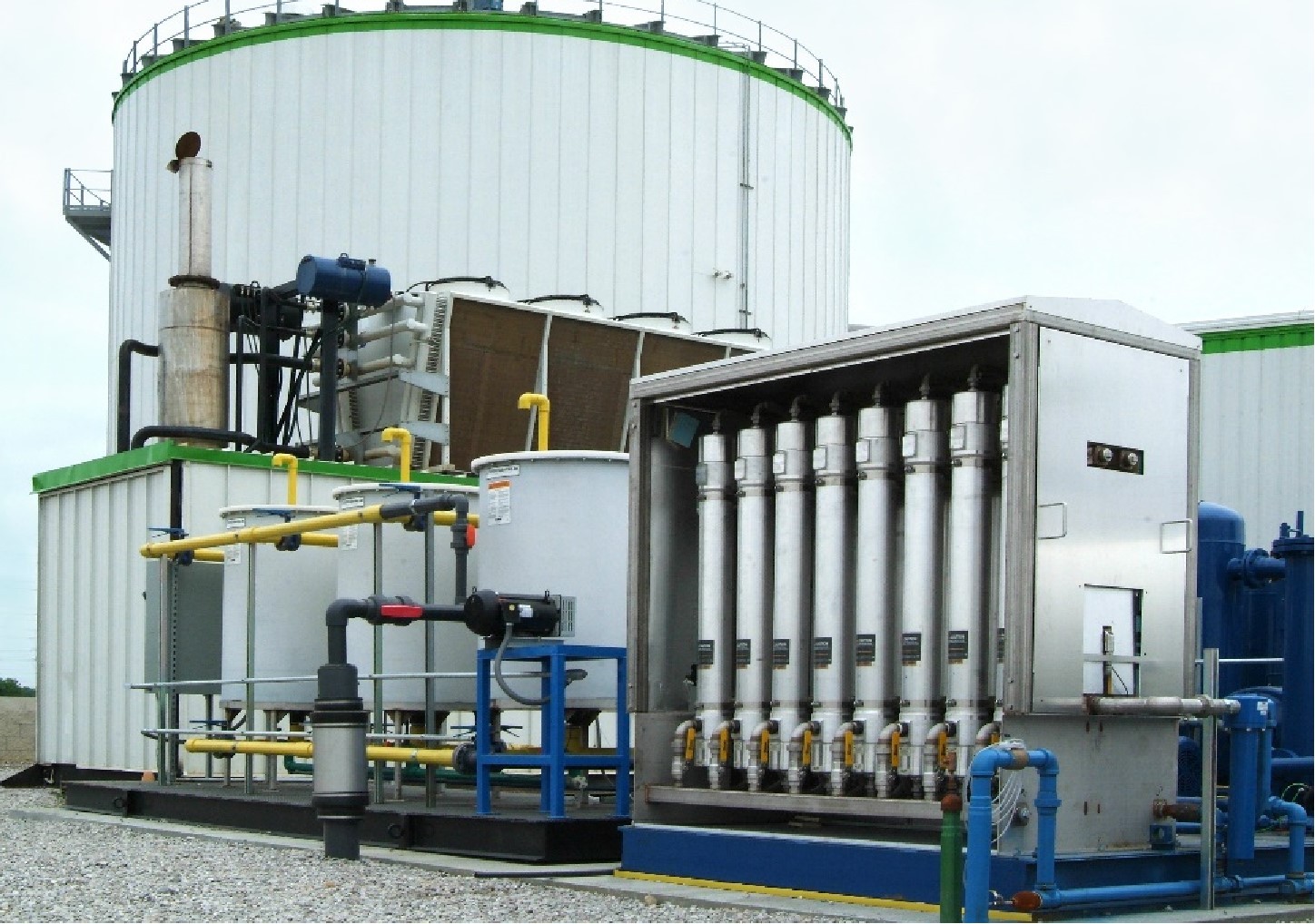
Integrating raw gas production with advanced biomethane purification equipment requires strict delivery pressure, humidity management, and chemical stability. Downstream scrubbing infrastructures, such as selective polymeric membranes or chemical amine scrubbing plants, demand clean, pressurized gas streams. Because feedstocks with high organic solids often yield elevated levels of H2S due to concentrated sulfur-bearing proteins, multi-stage desulfurization systems become mandatory before compression.
From an operational standpoint, specifying a modern plug flow anaerobic digester requires an end-to-end perspective that connects biological conversion directly to gas processing. Digestate discharge rates must balance incoming biomass volume precisely to maintain absolute liquid-level containment, ensuring gas headspaces remain isolated from atmospheric oxygen intrusion. Automated pressure transducers tied directly to variable-frequency gas blowers compensate instantly for production peaks, feeding raw biomethane through particulate filtration, chilling dryers, and deep H2S polishing beds before upgrading membranes convert the stream to pipeline-grade renewable natural gas (RNG).
Operational Comparative Analysis: Plug Flow vs Complete Mix Systems
Selecting a plug flow anaerobic digester over a standard mixed vessel fundamentally alters capital allocation toward heavy solids management. The functional distinctions become prominent when evaluating fluid management, operational complexity, and parasitic power consumption.
Water Conservation: Complete mix setups require large volumes of fresh or recycled water to lower incoming solids down to pumpable ranges (typically below 10% to 12% total solids). Plug flow infrastructure eliminates the need for dilution water, drastically reducing the net volume of liquid digestate requiring subsequent dewatering, storage, and field transportation.
Parasitic Electrical Consumption: High-speed agitation of large-volume liquid digesters consumes substantial, continuous electrical power. Slowly turning low-RPM shafts and hydraulic displacement configurations draw power intermittently, shifting overall facility energy balances toward net positive generation.
Pathogen Destruction Consistency: Complete mix reactors exhibit a continuous distribution of retention times; some substrate leaves the system hours after injection, carrying viable weed seeds and pathogens. Plug flow physics enforces strict minimum residence duration for every kilogram of material, achieving thermal sanitation compliance without requiring external pasteurization units.
Overcoming Operational Deterrents in High-Solids Digestion
High-solids digestion presents specific operational difficulties that require focused engineering interventions during structural design.
Heavy inorganic matter, primarily sand, soil, and small stones from agricultural harvesting or animal bedding, introduces continuous sedimentation challenges. In dilute systems, heavy particles sink rapidly to vessel bottoms, requiring frequent vessel draining and manual cleanouts. Plug flow units utilize the elevated yield stress of high-viscosity slurries to suspend heavy particles within the moving biomass packet, carrying sediment toward the mechanical discharge end. For operations with severe sand burdens, specialized sloped troughs and floor scraper flight systems are implemented to eject settled grit continuously without taking the digester offline.
Crust formation poses a parallel mechanical concern. Fibrous materials naturally float when buoyancy forces overcome fluid drag. Without adequate vertical reincorporation, these fibers knit into an impervious layer, locking gas below the surface and placing immense stress on vessel ceilings. Slow-revolution longitudinal reels equipped with angled scythes break this structural network continuously, submerging dry dry fibers back into the active microbial core and clearing pathways for smooth biomethane release.
Engineering Inquiries and Project Specifications
Integrating high-solids biological treatment with advanced gas upgrading infrastructure requires comprehensive initial substrate characterization, fluid dynamic modeling, and structural balance across all unit operations. Facility developers must balance total solids percentages, internal retention profiles, and desulfurization methods against the precise operational requirements of downstream biomethane upgrading systems.
Our engineering team designs, fabricates, and deploys fully coordinated biomethane systems adapted precisely to high-solids organic processing demands. Send your project parameters, feedstock analysis, and throughput targets to our application engineers today to receive a complete engineering appraisal and process configuration blueprint.
Frequently Asked Questions
Q1: What substrate dry-matter content is recommended for a plug flow anaerobic digester?
A1: Horizontal plug flow systems typically
process substrates containing between 15% and 30% total solids (TS). Materials
falling below 12% TS generally lack sufficient yield stress to sustain true
piston flow, shifting fluid behavior toward mixed-tank regimes and permitting
settling of heavy particles. Solids levels exceeding 35% often lead to excessive
friction, demanding extreme mechanical torque for agitation and transport.
Q2: How is short-circuiting prevented without internal physical
baffles?
A2: Short-circuiting is inhibited through the natural
rheology of high-solids non-Newtonian slurries and a high length-to-width vessel
aspect ratio, typically 4:1 or greater. The yield stress of the thick substrate
resists localized streaming. When paired with low-speed, radial agitation
sweeps, the mass moves forward uniformly, ensuring all fractions remain in the
reactor for the full duration of the design retention period.
Q3: How do operators address volatile fatty acid accumulation in the
primary inlet zone?
A3: When dealing with rapidly acidifying inputs,
process designs incorporate an internal or external digestate recirculation
loop. Reintroducing a fraction (10% to 25%) of actively digesting,
methanogen-rich effluent from the discharge end back into the incoming raw
feedstock provides instant alkalinity buffering and immediate microbial
inoculation, preventing pH suppression below functional biological levels.
Q4: What desulfurization approach pairs best with high-solids
horizontal digesters?
A4: Because dry-digestion systems yield
concentrated biogas with volatile H2S peaks, biological in-situ micro-aeration
may face surface-area transfer limitations within viscous substrates. The most
dependable method pairs coarse external biological scrubbers or chemical
iron-sponge beds directly with dry-type catalytic media or regenerable chemical
absorption units, stabilizing the gas before it enters downstream gas separation
membranes.
Q5: Can multiple high-solids feedstocks be co-digested within the
same horizontal reactor?
A5: Yes. Co-digesting structural materials
(such as manure or straw) alongside dense, nitrogenous, or sugar-rich substrates
(such as food residuals) is common. The prerequisite is a dedicated upstream
feedstock preparation and blending system that homogenizes the recipe to a
consistent viscosity and particle size (typically below 50 mm) before hydraulic
injection into the primary digestion vessel.