


News
We'll get back to you as soon as possible.
6 Process Stages for Upgrading RNG Biogas to Pipeline Quality
Raw biogas generated via anaerobic digestion or landfill methanogenesis is fundamentally an unrefined energy carrier. Composed primarily of methane and carbon dioxide alongside corrosive contaminants, atmospheric intrusions, and trace volatile compounds, raw biogas requires substantial physical and chemical upgrading before it can integrate into fossil gas infrastructure. Processing raw methane streams into commercial-grade rng biogas demands continuous separation sequences engineered to satisfy transmission pipeline specifications or vehicle fuel standards without unscheduled operational stoppages.
Meeting pipeline tariffs requires precise separation mechanics. When industrial plants process raw anaerobic digester gas, they must systematically remove sulfur compounds, eliminate water down to trace dew points, strip siloxanes and volatile organic compounds (VOCs), and extract carbon dioxide. Achieving high methane recovery rates while preventing methane slip into the atmosphere forms the mechanical baseline of modern biomethane production plants.
Feedstock Variability and Chemical Foundations of Raw Biogas
Biogas compositions vary widely depending on the biological substrate fed into the anaerobic digestion system or the operational conditions of landfill extraction fields. Process equipment must accommodate these variations to avoid operational disruptions.
Dairy and Swine Manure Digestion: Manure-derived gas typically features high methane concentrations (60% to 68%) paired with severe hydrogen sulfide loadings, regularly spanning 2,000 ppm to over 6,000 ppm. Ammonia presence and high moisture saturation are constant baseline conditions.
Industrial Wastewater and Sewage Sludge: Municipal wastewater digesters generate gas with moderate methane levels (55% to 62%) and lower sulfur loadings. However, this substrate introduces elevated levels of volatile methyl siloxanes (VMS), cyclic siloxanes (D4, D5, D6), and halogenated compounds derived from household and industrial cleaning detergents.
Landfill Gas Extraction: Landfill methane streams present reduced baseline methane concentrations (45% to 55%) paired with atmospheric balance gas leakage. This introduces nitrogen (frequently 5% to 15%) and oxygen (1% to 3%), alongside non-methane organic compounds (NMOCs) and aromatic hydrocarbons such as benzene, toluene, ethylbenzene, and xylene (BTEX).
Because downstream separation elements—particularly polymeric membranes and chemical solvents—are vulnerable to fouling, identifying the exact inlet gas matrix dictates the sequence of upstream protection stages.
Primary Pre-Treatment: Sulfur, Moisture, and Halogen Remediation
Raw off-gas exiting anaerobic digestion headers arrives saturated with water vapor at temperatures between 35°C and 42°C. Moving this raw stream directly to high-pressure stages leads to acid gas condensation, severe pipe corrosion, and rapid mechanical degradation of rotating compressor elements.
Gross and Fine Desulfurization Systems
Hydrogen sulfide ($H_2S$) forms sulfurous and sulfuric acids upon contact with water, rapidly pitting carbon steel pipe walls and denaturing downstream separation media. Primary gross desulfurization frequently utilizes biological trickling filters or chemical oxidation towers where sulfides undergo oxidation into elemental sulfur or sulfate salts. For streams requiring polishing to sub-ppm levels, process designers deploy regenerative or sacrificial dry media scrubbers. Fixed-bed vessels containing granular iron oxide or solid metal hydroxides react with $H_2S$ through exothermal gas-solid surface reactions, consistently lowering concentrations below 1 to 2 ppm.
Chilling, Dew Point Suppression, and Coalescence
Gas conditioning begins with bulk moisture removal. Industrial heat exchangers lower the gas temperature to approximately 3°C to 5°C using closed-loop glycol refrigeration units. This thermal drop forces bulk water vapor past its saturation point, condensing it into liquid form. Cyclonic drop-out vessels and micro-fiber coalescing filters capture the suspended water droplets and particulate matter down to 0.1 microns, draining the acidic condensate out of the process stream before the gas proceeds to media adsorption.
Deep Hydrocarbon and Siloxane Extraction
Siloxanes volatilize within digesters and landfills, entering the gas stream as trace vapors. If combustion occurs in the presence of silicon compounds, white silica deposits form on heat exchangers, turbine blades, and reciprocating engine valves, leading to abrasive mechanical failure. To eliminate this operational challenge, plants route the chilled biogas through twin-tower regenerative Temperature Swing Adsorption (TSA) skids or deep-bed activated carbon vessels. Tailored carbon pore structures adsorb heavy VOCs and siloxanes, maintaining clean gas feed into the main separation units.
Advanced Separation Technologies for RNG Biogas Purification
Extracting carbon dioxide ($CO_2$) constitutes the most energy-intensive process step within rng biogas refining. Because carbon dioxide constitutes 35% to 50% of the raw gas volume, selecting the appropriate bulk separation mechanism dictates the operating efficiency and biomethane recovery rate.
Multi-Stage Polyimide Membrane Separation
Gas separation membranes rely on differential molecular permeation rates through hollow-fiber polymer strands, typically constructed from robust polyimide materials. Driven by partial pressure differentials created by feeding pressurized gas (12 to 16 barg) across the bundle, "fast gases" like $CO_2$, $H_2O$, and remaining $H_2S$ permeate rapidly through the polymer matrix to the low-pressure shell side. Methane, classified as a "slow gas" due to its larger kinetic diameter and lower solubility, is retained within the fiber bore.
State-of-the-art systems apply a three-stage cascade design with internal recycle streams:
Stage 1 (Primary Split): Separates the pressurized bulk gas, delivering high-purity methane retentate and an intermediate permeate.
Stage 2 (Methane Scavenging): Receives the Stage 1 permeate to recover methane that slipped through the initial polymer barrier, compressing and returning it to the Stage 1 suction header.
Stage 3 (Final Polishing): Treats remaining gas fractions, generating an off-gas stream consisting of over 98% pure $CO_2$ while retaining overall plant methane recovery above 99.2%.
Pressure Swing Adsorption (PSA) Systems
Pressure Swing Adsorption operates on the differential adsorption equilibrium of gas molecules on solid adsorbents under pressure variations. Carbon molecular sieves (CMS) or synthetic zeolites feature precisely calibrated pore windows matching the size of $CO_2$ molecules (approximately 0.33 nm). Under high operating pressures, $CO_2$ diffuses into the adsorbent micropores, while the larger methane molecules (0.38 nm) bypass the structure, flowing out as refined product gas. Sequential depressurization, vacuum evacuation, and counter-current purging desorb the captured $CO_2$, preparing the bed for subsequent loading cycles.
Chemical Amine Scrubbing
Amine systems utilize reversible chemical reactions between basic aqueous alkanolamine solutions (such as monoethanolamine [MEA] or methyldiethanolamine [MDEA]) and acidic $CO_2$ molecules inside counter-current packed absorption towers. Amine scrubbing routinely achieves methane purities surpassing 99% with methane slip figures consistently below 0.1%. However, the solvent regeneration sequence requires an auxiliary boiler to heat the rich amine solution to 110°C to 120°C, making this technology best suited for sites with abundant, inexpensive thermal energy sources.
Balance of Plant and Compression Engineering
Biogas processing plants operate under stringent thermodynamic and mechanical duties. Selecting compression equipment requires careful evaluation of volume throughput, discharge pressures, and long-term mechanical reliability.
Rotary screw compressors handle intermediate pressure duties (up to 16 barg), providing smooth gas delivery with low vibration levels. Internal fluid injection cools the gas during compression, absorbs mechanical heat, and seals the internal rotor clearances. Downstream separator vessels, followed by coalescing filtration stages and final polishing carbon beds, lower synthetic lubricant carryover below 5 parts per billion (ppb) to prevent solvent or membrane contamination.
When injecting finished rng biogas into regional transmission lines operating between 40 and 80 barg, multi-stage reciprocating compressors take over the high-pressure duty. These machines feature non-lubricated or crosshead configurations with dynamic piston ring packings to preserve absolute gas purity under severe differential pressures.
Pipeline Interconnect Specifications and Gas Quality Verification
Natural gas pipeline operators enforce strict tariff standards to safeguard pipe integrity, protect downstream consumer appliances, and prevent delivery disruptions across their systems. Purified biomethane must mirror conventional geological gas across multiple chemical and thermodynamic parameters.
Higher Heating Value (HHV) and Wobbe Index: Biomethane consists almost entirely of methane, resulting in an HHV around 1,010 BTU/scf, which is sometimes lower than geological gas rich in ethane, propane, and butane. When required, thermal enrichment systems inject vaporized propane via precise mass flow controllers to raise the heating value to local utility thresholds.
Oxygen and Nitrogen Limits: Strict utility standards enforce oxygen thresholds between 0.2% and 10 ppm, alongside total inerts ($N_2 + CO_2$) restricted to 2% to 4%. Landfill projects often integrate catalytic deoxygenation units or cryogenic nitrogen rejection units to eliminate balance air introduced during field extraction.
Trace Contaminant Thresholds: Moisture levels must not exceed 4 to 7 lbs/MMSCF (achieving a dew point below -40°C), while total sulfur is limited to 0.25 to 0.5 grains per 100 scf (around 4 ppm), and volatile siloxanes must remain undetectable (typically < 0.1 mg/m³).
Continuous monitoring relies on dedicated gas chromatographs (GC) cycling every 3 to 5 minutes, paired with tunable diode laser absorption spectroscopy (TDLAS) analyzers measuring moisture and $H_2S$ continuously. If any monitored variable drifts beyond specified limits, an automated fast-acting slam-shut valve isolates the pipeline interface within 500 milliseconds, instantly redirecting the non-compliant stream back to a flare or recycle storage loop to prevent utility off-spec delivery penalties.
Field Architecture: Modular Skids versus Field Construction
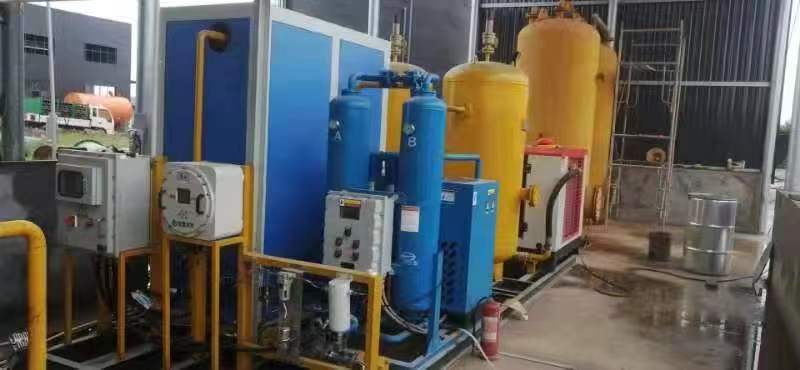
Executing an industrial upgrading facility involves balancing civil construction schedules with factory engineering execution. Traditional field-erected plants introduce weather-related scheduling delays, complex on-site piping fabrication, and labor coordination challenges across diverse trades.
Modern developers increasingly select modular, skid-mounted architectures. Pre-assembling membrane arrays, chilling stages, media vessels, and motor control centers onto structural steel frames inside clean manufacturing environments accelerates project execution. Factory acceptance testing (FAT) confirms structural piping integrity, hydro-tests process lines, verifies instrumentation wiring loops, and audits safety instrumented systems before delivery. On-site installation reduces to establishing concrete foundation pads, routing external utility connections, and landing the pre-wired process headers.
Standardizing mechanical interfaces within engineered rng biogas infrastructure provides project certainty, enabling operators to streamline commissioning timelines and establish stable continuous operations shortly after arrival on site.
Initiate Your RNG Upgrading Project with Industry Specialists
Developing a high-performance biomethane upgrading facility demands rigorous process modeling, industrial component sizing, and deep knowledge of transmission pipeline compliance standards. Our engineering team designs and manufactures complete, skid-mounted systems capable of processing diverse biogas feeds into high-purity product streams.
Contact our application engineering division today to submit your raw gas analysis, project throughput data, and off-take delivery parameters for a comprehensive engineering evaluation and tailored equipment configuration.
Frequently Asked Questions
Q1: What defines the purity threshold for RNG biogas entering
commercial pipelines?
A1: Commercial utilities typically mandate a
methane content of 96% to 99%, carbon dioxide below 1% to 2%, total inerts ($N_2
+ CO_2$) under 3% to 4%, oxygen below 0.2% (or down to 10 ppm in specific
transport lines), and complete absence of detectable liquid water, siloxanes,
and particulates.
Q2: How does a three-stage membrane configuration prevent methane
loss?
A2: In a three-stage membrane process, the permeate gas from
the primary separation stage contains a minor amount of co-permeated methane
alongside carbon dioxide. By routing this permeate stream through a secondary
membrane array, the system separates the residual methane, directing it back to
the main compressor inlet. This continuous internal recycling maintains overall
methane recovery rates above 99%.
Q3: Why must siloxanes be stripped before the gas enters compression
and separation?
A3: Siloxanes carry into the gas stream as trace
vapors but cause severe damage if unaddressed. Within mechanical compressors,
siloxanes deposit abrasive layers on components, and when exposed to downstream
thermal oxidizers or end-use combustion engines, they form hard
micro-crystalline silicon dioxide deposits that erode metal surfaces and ruin
precision equipment.
Q4: Under what conditions is propane enrichment required in
biomethane production?
A4: Geological natural gas typically contains
heavy hydrocarbon fractions such as ethane, propane, and butane, giving it a
higher heating value (HHV). Upgraded biomethane consists almost entirely of pure
methane, which has a slightly lower baseline HHV. If the local utility's Wobbe
Index or calorific value standards require a richer energy density, a controlled
propane injection skid doses precise amounts of LPG into the finished rng
biogas to achieve full fuel parity.
Q5: How do temperature swing adsorption (TSA) units function in
biogas pre-treatment?
A5: TSA systems utilize dual adsorbent beds
packed with specialized media. One vessel operates online at lower temperatures,
stripping VOCs, siloxanes, and heavy hydrocarbons from the gas stream.
Meanwhile, the offline vessel undergoes thermal regeneration: a heated dry gas
stream desorbs the trapped contaminants and carries them out of the media
matrix. Once cooled, the regenerated vessel returns to duty, switching roles
with the loaded vessel to enable uninterrupted round-the-clock purification.